

Program Details
Information about medical programs provided by each healthcare institution, including treatment details, schedules, etc.,
- Kanto / Tokyo
- medical treatment
- orthopaedic surgery
- arthritis(joint pain)
- spine
CBTmethod(cortical bone trajectory)(Murayama Medical Center)
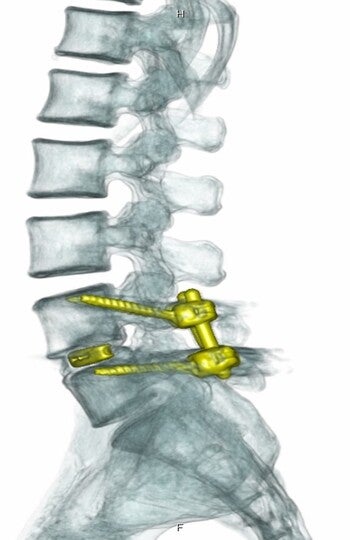
This is a muscle-friendly posterior lumbar fusion technique. Using intraoperative fluoroscopy, screws are inserted into the cortical bone (the hard part of the bone) from the inside to the outside and from the caudal to the head. Although technically very advanced, it provides a patient-friendly procedure with minimal blood loss and mild postoperative pain.
This is for conditions where there is instability of the lumbar spine and numbness, pain, and paralysis have appeared. Lumbar disc herniation, lumbar spinal canal stenosis with instability, and lumbar spondylolisthesis are the targets.
This procedure is a muscle-preserving posterior lumbar fusion surgery.
During surgery, intraoperative fluoroscopy (X-ray imaging) is used to insert screws into the cortical bone (the dense outer layer of bone). The screws are inserted from the medial to the lateral side and from the caudal to the cranial direction.
Although this procedure requires highly advanced surgical techniques, it involves minimal bleeding and mild postoperative pain, providing a patient-friendly surgical treatment.
This surgery is indicated for patients with lumbar spinal instability causing symptoms such as numbness, pain, or paralysis.
Typical conditions include:
Lumbar disc herniation
Lumbar spinal canal stenosis with instability
Lumbar spondylolisthesis
Depending on the extent of the lesion, the surgery is performed under general anesthesia with a 5–8 cm vertical incision in the lower back. The muscles are carefully separated to expose the surgical field.
Using intraoperative fluoroscopy, screws are inserted into the cortical bone.
Compared with conventional techniques, this method requires less muscle detachment and preserves the facet joints, helping to prevent postoperative spinal deformity and reduce bleeding.
Surgery time: approximately 2 hours
Estimated blood loss: about 50 ml
Postoperative care: patients remain in bed for the first 2 days
Walking: possible from the 3rd postoperative day
Discharge: usually about 10 days after surgery once the wound has stabilized
Over the past three years, the hospital has performed an average of 209 lumbar fusion surgeries per year.
In lumbar spine surgery, complete disappearance of symptoms cannot always be guaranteed.
Some patients may continue to experience numbness, pain, or residual paralysis.
In rare cases, neurological symptoms may worsen.
A small number of patients may develop postoperative infections. If this occurs, additional surgery under general anesthesia may be required, which may extend the hospital stay.
In 2025, the postoperative infection rate was 0.9%.
- Providing Medical Institution
-
Independent Administrative Institution National Hospital Organization Murayama Medical Center
〒208-0011https://murayama.hosp.go.jp
2-37-1 Gakuen, Musashimuurayama-shi- Specialty
- Spinal cord surgery Artificial hip joint surgery Artificial knee joint surgery